Followers

Wednesday, April 17, 2013

Day 17 brings double dactyls

Aprille has encouraged us to write double dactyls for the 17th day in our poem-a-day-for-April challenge. Seems somehow fitting she should do so.
A dactyl is a word with the EMphasis on the first SYLlable: for instance, the word APril seems self-evident.
But what of Aprille? Is that her mother's choice of spelling for the name April? Or is it pronounced in the European way: Aprille?

This is what we like at the Imaginary Garden with Real Toads: a challenge with a quandary in it, accompanied by encouragement.

Another thing we like is an illustration of the form, which Aprille gives as follows:

ONE two three ONE two three
ONE two three DONE

and a brilliant idea: "Just think of a waltz," she says.

Don't forget a statement of requirements...
a double dactyl has two stanzas (i.e. two of the above)
and contains one proper noun/name
plus one 6-syllable word,
with no particular rhyme scheme.

Aprille provided a handy list of dactyls and another of 6-syllable words which are double dactyls. Of course, I just had to play around with some of those:

authoritarian
octogenarians:
conspiratorial,
unconstitutional:
dubious Senators all

So, I overdid the 6-syllable words and didn't get anyone's name in, but Senator with an uppercase S is arguably a proper noun? Isn't it? Anyone want to argue? Or do I have to argue with myself? (Not impossible.)

Fortunately, Aprille included two of her paintings of England in the 70s when infrastructure was breaking down. One contains a dog who looks like a Golden Retriever, so I definitely had to write to that.

Copyright. Used with permission.

bicycle is useless
overloaded, tires flat,
humanitarian
dog can tell that

hazardous woodlands here
helping hands not so near
he’ll guide you til you reach
Hill Farm ahead

Kay Davies, April 17, 2013


Tuesday, April 16, 2013

April 16th, time for a form challenge

Marian has offered two forms, which the Imaginary Garden with Real Toads has seen before, and is letting us choose our favorite for a "brand new, fresh-as-spring poem".
I've been thinking of roundels and rondelets for 24 hours, for my April 16 poem, but nothing resembling poetry issued from this keyboard.
Hmm. "Palatable" Marian calls these forms. That's rather appealing to my food addiction, so maybe, after my recent travels with my husband...


So here is my rondolet, entitled
Eating in Italy


Love may be the king
but food is for certain the queen,
love may be the king
as Dean Martin once used to sing,
but everywhere there we have seen
pasta dishes fit for a queen,
though love may be king.
Kay Davies, April 16, 2013       

Pasta specialty shop, Venice. Wikipedia photo.

Monday, April 15, 2013

Passing through for Our World Tuesday


To travel through Italy, we used the train. Many places were just names on signs beside the track as we sped by.


Richard Schear photos, February and March, 2013
Modern advertisements contrast sharply
with elegant old railway stations.

Posted for
Click to see
other worlds.

Signs similar to this one, which shows the route between Pisa and Florence, were supposed to be in every train car. In some, however, we found them lacking, which resulted in some confusion on our part, we must admit.

Sunday, April 14, 2013

Open Link Monday, 15th of my poems-a-day

Monday is a sort of day off at the Imaginary Garden with Real Toads. We have no prompt to write to, no photos to inspire us, although Kerry did include some pretty flowers to make northern-dwellers think of Spring, which is an illusion here, so far, at best. Now we are submitting to Day 15 of our poem-a-day challenge, and I'm still here to annoy you.

I may have recently mentioned Rudyard Kipling. I am of an age when I can get away with mentioning him from time to time, and I also live in an area where many people, who have never memorized any of his poems, still remember that he came through here by train in 1907 and called Medicine Hat, Alberta, "the city with all hell for a basement."

Of course, the world now sees Alberta as the Canadian province with oil for a basement, with senior levels of government hell-bent on sending that oil by pipeline, ship, tanker truck, train, milk cart, or mule team around the world at a serious risk to the Canadian environment. The Canadian federal government has no interest in such things as global warming, sick kids, the environment, endangered species, or the melting of the polar ice cap, but has an abiding interest in oil extracted from the earth by whatever means possible and legislated into transportation by any other means possible, and has therefore met a friend in need, a friend indeed, in the Alberta government.

This made me, for the second time this year, think of Rudyard Kipling, and how he would feel about throwing out the baby (the population) with the bathwater (the oil from the Alberta tar sands).

Unfortunately, I couldn't channel him in order to get his opinion, but I did get unspoken permission to mess with one of his poems, which is almost as good. You'll see I haven't written anything serious at all, because I almost never do.

"Iffen"
(I have to call it Iffen because Kipling himself already wrote "If", you see.)

Iffen


If you can keep your hat when all about you 
Are losing theirs and blaming it on God
Who made the wind, but didn’t drag them out there.
If you can trust your wife when all men doubt her
But make allowance for her doubting them.
If you can waltz and not be tired of waltzing,
Or being tied about with chains and lies,
Nor yet not look too good, nor talk too wise...

If you can walk with dogs and keep your kibble,
Or cat with queens, nor lose the softer touch,
And win, then hide up all your winnings,
To twist the knives and make a trap for fools,
If you can fill an unamusing minute
With a minute’s worth of international news,
If you can force your stomach, heart, and sinews
To serve your turn, long after you are gone,
And so hold on when nothing else is in you...

If you can keep your hat when all about you
Have lost theirs in the wind and then blamed you...
You’ll be a woman with bonnet tied, my son!
                                          Kay L. Davies, April, 2013


Pet Pride: Lindy is so happy for Bozo

Posted for Pet Pride
hosted by Lindy's friend Bozo and his family in Mumbai, India, where Bozo is waiting for his family to come back after a trip.

Bozo's family has been away for a  l-o-o-o-ng  time, without him. Lindy says, "I'm so happy for Bozo to get his family back, I'm rolling around on the ground!"


Photo by Lindy's daddy, Richard Schear. Posted by Lindy's mommy, Kay Davies. April, 2013

Shadow Shot Sunday in Roman ruins

 Posted for Shadow Shot Sunday 2

A youngster ignores Rome's historic past in favor of chasing pigeons.
He and his bicycle throw shadows, as do the ruins of centuries long gone,
and tourists bent on buying postcards and souvenirs.
Richard Schear photos, March, 2013


Joaquín Sorolla, painter of light and water

Hedgewitch has introduced to the Imaginary Garden with Real Toads, a Spanish impressionist who loved to paint sunlight and water. Joaquín Sorolla, although orphaned as a child, was raised by his maternal aunt and uncle, who recognized his talent and had him educated in art from the age of eight, starting at home in Spain and eventually in Italy.

Hedgewitch suggests a short ekphrasis type of poem, perhaps haiku or another of the short poetic forms, or invites us to choose free verse up to 100 words, and she has provided ten wonderful examples of Sorolla's art.
In my own research, I found many more, and was hard-pressed to choose among the many.

For instance, the painting which set Sorolla free from the necessity of portraiture and salon art is called Triste Herencia, or "Sad Inheritance", showing crippled children bathing in the sea under the watchful eye of a monk. It made the world aware of the effects of a polio epidemic, and aware of the artist at the same time.


Sad Inheritance, 1900
The artist's wife and daughters
in the garden, 1900,
showing how he enjoyed
the play of light and shade.


Walk on the Beach, 1909.
The bright light at seaside was always one of Sorolla's favorites.


My own favorites, however, are the ones below, both of them showing mothers with infants. The tenderness of a happily married artist, with children of his own, is, to me, unmistakable in these two studies of maternal warmth.

sleeping child
watchful mother
smiling to herself
no bliss could be
as much to me
as seeing thee
thyself


I'll just
hold you,
shall I?
Before I
put you 
down.
You might
need a
mother's touch
before dawn.


Kay Davies, April, 2012, Day 14 of the Real Toads poem-a-day challenge for April


Saturday, April 13, 2013

Response to Billy Collins about fishing

Today's challenge at Imaginary Garden with Real Toads was posted by a lovely toad named Lola Mouse, who introduced the deceptively simple poems former US poet laureate Billy Collins writes about everyday life, with a twist.
Collins wants students of poetry to "take a poem and hold it up to the light" but finds, instead, "all they want to do is tie the poem to a chair with rope and torture a confession out of it"!
Public Domain photo, Rainbow Trout
In tutoring myself about Billy Collins today, I found a poem I, as a daughter of the late outdoor writer Gordon Davies, could relate to. Take a look at the link, then read my response, below.

To Mr. Collins
Sir:

If I ever get to the Susquehanna
I might fish there,
Public Domain photo, Rainbow Trout
as fishing is in my blood.
It was a pleasure
shared with me by my father
and my mother:
Standing knee deep in water
and tossing a
worm-ended line.
For minutes or hours there
under the sun
in a broad-brimmed hat.
Hoping to feel the tug on the line
that meant a trout had seen
and met my worm.
With no tug on the line
and no trout with the tug
then I’d just spent an afternoon
drowning worms
with my father
and my mother,
as we did, years before they died.

Also posted for Camera Critters,
hosted by Misty Dawn. Thanks, Misty!

Friday, April 12, 2013

Chelsea Bednar's artwork for Day 12


"Of all the arts, abstract painting is the most difficult.  It demands that you know how to draw well, that you have a heightened sensitivity for composition and for colors, and that you be a true poet.  This last is essential."  -

Hello toadies and roadies...wishing you a happy Friday and a good weekend, while we choose a piece of Chelsea Bednar's artwork, provided for our inspiration by Margaret on Day 12 of our April poem-a-day challenge at the Imaginary Garden with Real Toads.
I can't help but wonder how many of us have been regular, daily contributors since this not-an-April-fool's-day-joke began. I've thought of going back and making a list, but that sounds too much like work. I'm sure, by month's end, someone (much smarter than I) will be able to tell us who hung in here, who skipped a day, who doubled-up after missing a day, and who dropped out altogether.
In the meantime, we have had several pieces of Chelsea's art from which to choose, plus a quotation Margaret provided, which blurs the line between artist and poet. Distilled, it says "in order to be an abstract painter, you must be a true poet"! I'm glad it didn't say "in order to be a poet, you must be a true abstract painter" because that would have left me out.


Original artwork by Chelsea Bednar

the girls sat at the river's mouth
and contemplated nature
referring to a heavy book
"Botanical Nomenclature"

they made a list of all they saw
and entered it on a cell phone
and made a drawing of each leaf
and flower and stem and rhizome
  
it took them days (they had a tent)
to draw each plant they saw then
but on they drew, and on and on,
for a whole long weekend

publicdomainpictures.net George Hodan
exhausted,
they
trudged
home, on
Tuesday
morning,
waking
parents,
siblings,
dogs,
with
hardly
any warning,
but they learned well,
and knew full well
they didn't like botanical-ing,
but they are well-known artists now
with a large botanical following
Kay Davies, April 12, 2013


Thursday, April 11, 2013

Colossal skies at Roman Colosseum


Richard Schear photos, March, 2013
Posted for
Skywatch Friday

The highlands, the islands, and me. Day 11


Alba an Aigh — Scotland the Brave

With my brother, Clint Davies
2007
Part 1. Brotherly Love

“Far be it from me, your nearest sibling, to suggest you’re gullible, but...”
“Oh, sure, far be it from you! I tell you, I could feel it. I could.”
“We’d just gotten off that sardine can that Air Transat called a plane...”
“I know, I know, and it was nice to be let loose, but it wasn’t just relief I felt, it was more, much more.”
Richard Schear photo
Venice, Italy, 2013
“Excitement, then. We talked about visiting there all our lives. Of course you felt something.”
 “It wasn’t excitement. Excitement was that time we rode the train by ourselves when we were kids. This was a calm feeling, it just felt right. I tell you, it was genetic memory.”

“At the risk of mentioning your gullibility again, you never thought of genetic-anything from the time you studied the monk Mendel and his pet guinea pigs in junior high, until last month when the Brits cloned that sheep they call Dolly. That’s probably what put the whole idea in your head. Face it, you’re not a scientist, you’re a dreamer, a writer, a poet...”
“Don’t say ‘poet’ in that tone of voice, as if it’s a disease!”

Part 2. Where Tourists Go

I want to see the highlands
and the islands
I want to see Loch Lomond
and Loch Ness
to hear a single piper
play a pibroch on a hill
and a hundred pipers
marching at the
Edinburgh Tattoo

Part 3. Where Tourists Don’t

to feel again the pull I felt
as soon as I arrived
when Scotland called me
from its deepest heart,
when being there was plenty:
just walking slowly, gently,
feeling Scotland talk to me alone,
the country recognized me
as one of its lost souls
and welcomed me
returning to its folds
“Aye, lass, it’s you,” it told me
and let its arms enfold me
until I knew for sure
that I was home.

Part 4. Scientific Theory

In psychology, genetic memory is a memory present at birth that exists in the absence of sensory experience, and is incorporated into the genome over long spans of time. It is based on the idea that common experiences of a species become incorporated into its genetic code, not by a Lamarckian process that encodes specific memories but by a much vaguer tendency to encode a readiness to respond in certain ways to certain stimuli.*
Genetic memory is invoked to explain the racial memory postulated by Carl Jung. In Jungian psychology, racial memories are posited memories, feelings and ideas inherited from our ancestors as part of a "collective unconscious".
In contrast to the modern view, in the 19th century, biologists considered genetic memory to be a fusion of memory and heredity, and held it to be a Lamarckian mechanism. Ribot in 1881, for example, held that psychological and genetic memory were based upon a common mechanism, and that the former only differed from the latter in that it interacted with consciousness. 

* These italics are mine.

Corey, known as Herotomost at the Imaginary Garden with Real Toads, where he certainly is a hero to many, has challenged us to "write a narrative about a place that is special" and "sandwich the narrative between two pieces of dialogue."
Because Corey said our narrative could be scientific, I transferred that permission to the outside of my "sandwich" where it fit best.
This challenge was a lovely surprise following an e-mail I wrote to a friend in the UK this week. She had asked me about my favorite place in my many travels, and I mentioned the gentle, pleasant, homecoming feeling I think of as genetic memory, when told her why I chose Scotland. 

Common toad, Scotland
I was there with my parents, siblings and siblings-in-law in 1996. I think I was the only one to feel the strong pull of the land as soon as we left the plane, even though both of my parents are one generation closer to our Scottish heritage than I am. 
This is my submission to Day 11 of the April poem-a-day challenge at the Imaginary Garden with Real Toads.


Wednesday, April 10, 2013

Document of Discussion, for Day 10

Izy says, and she's very often right, that important conversations are often taken down verbatim for legal reasons, and become Documents of Discussion.

She has asked us, for the tenth day of our poem-a-day challenge this April, to prepare a Document of Discussion, of a conversation real or imaginary.

Of course, none of the circumstances below should be any surprise to those who know Mama Zen, Hedgewitch, and Fireblossom from the Imaginary Garden with Real Toads. Of course we expect them to be singled out for singular honors and crowned with flowers and made members of the Order of the British Empire, and everything else. But I leave it to you to decide whether this Document of Discussion records a real or imaginary conversation. (The fact that it is now 1:30am should not influence your decision.)
* * *
Wikipedia photo

I wasn’t at all nervous about attending the tea at Buckingham Palace. I was a mere minion, a sort of editor-cum-proofreader for the real stars of the afternoon: Mama Zen, Hedgewitch and Fireblossom. 

Their book had been made into a movie, and then into a stage play, and apparently the Queen of England loved it.

We had all learned to curtsy (although Shay wanted to bow) and learned to address the monarch as “Your Majesty” upon first meeting her, and thereafter as “Ma’am” although I certainly wasn’t expecting a thereafter, planning as I was to become a cross between a wallflower and a wooden Indian.

  
“Oh, there you are, when can you start?” asked the Queen.

“I beg pardon, Ma’am, I don’t know what you mean.”

“Well, you know I need one, and I’m sure you’ll do fine.”
  
“I’m sure I don’t know, your Majesty, Ma’am, please.”
  
“No, no, I told them, I looked over my list of employees,
  
 I have everyone else but, wouldn’t you know it?
  
 It seems I don’t have my own Poet Laureate.”

Wikipedia photo
After I fainted, Mama Zen patted my hand, Shay helped me up, and put me on a bench, while Hedgewitch scanned the royal tea table for a suitable herbal remedy: ginger, ginseng, echinacea, or lemongrass tea.

“Well, now,” said the Queen, “I do believe my grandmother Victoria had the same problem with Rudyard Kipling, after his Nobel Prize. He turned down a knighthood and the Poet Laureateship: the knighthood several times as I recall.”


Tuesday, April 9, 2013

Words Count with Mama Zen, for Day 9

The title of this post might have rhymed nicely if it had waited until tomorrow, but time, tide and poem-a-day challenges wait for no one. So we won't have:
Now day ten
with Mama Zen
who tells us when
to stop.
60 words
she says today
60 words
is tops.

Too bad, I might have enjoyed that. But Day 9 it is.

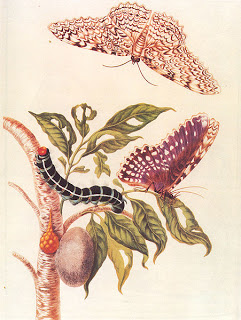
Instead of waiting until tomorrow for our rhyming pleasure, Mama Zen got all googly and found the amazing color drawings of Maria Sibylla Merian, an artist and naturalist who, probably to the shock and horror of her contemporaries, traveled from Amsterdam to Suriname, South America in 1699, unchaperoned except by her young daughter.
MZ offers us four illustrations from Metamorphosis Insectorum Surinamensium, from which to choose for our poems of yes, 60 words or less.

Anyone familiar with the Imaginary Garden with Real Toads will realize Mama Zen is the queen bee of brevity. That lady can pack more real meaning into 50 or 60 words than I can into pages of rambling, meandering, frivolous nonsense. Hard to believe, I know, but very true.


hello, said the caterpillar
to the moth
I’ll look like you one day
I eat these leaves
and then cocoon
for weeks
of beauty treatment.
you might not see
when I emerge
or you might —
if you aren’t
eaten by a bird


 43 words by Kay Davies, April 9, 2013


wow, said the butterfly to the bee
how differently aerodynamic are we:
my wings are large,
my body small
while you look like you
should not fly at all.

29 words by Kay Davies, April 9, 2013

Monday, April 8, 2013

Taking Daddy for a walk: Our World Tuesday

Richard Schear, photos
Hi, everyone. I'm Lindy. This picture was taken when I was letting my daddy take me for a walk. He thinks he is walking me on my leash, but I'm actually leading the way. Here, for instance, I decided to lie down for a minute.
But don't tell him I told you.
Wink, wink!
Posted for
Our World
Tuesday

Photo of the coulee near our house, from the path where Lindy walks her daddy.

Monday as usual, Day 8 of poetry challenge

It is Open Link Monday at the Imaginary Garden with Real Toads, but today's poems (old or new) count toward our poem-a-day for the Toads' April challenge.

I found my book of graph paper and intended to sketch a layout of the house after excess furniture and junk are removed, but, when I opened the book, I found a three-verse poem I wrote I-don't-know-when.  I see I've made the syllable count of each five-line stanza 5-7-5-7-7 but I can't remember why.

It's a sappy sort of springtime thing, with little or no redeeming value except to compare birds with mankind. Sort of oh-I-wish-that-I-could-be a-little-bird-up-in-a-tree. But, with 30 poems to do in 30 days, I takes 'em as I finds 'em, in a book of graph paper, or on the back of an envelope.


Richard Schear photos

day's sky clothed in grey
and night's sky clothed in black
give way to a dawn
of glorious enchantment,
intoxicating the birds.
*
day's sky wrapt in in blue,
bright birds soaring above green,
intoxicate Man
who sighs, unable to fly,
and weeps, chained to earth.
*
Man, the envious,
accomplishes much on Earth:
now flies, dives and soars
while birds, who do not envy,
still sing to welcome the dawn.
by Kay Davies

Photo by Gloria Johal

Sunday, April 7, 2013

Words of Wordsworth for Day 7 of challenge

The young Wordsworth
Kerry has reacquainted members of the Imaginary Garden with Real Toads with an old favorite: William Wordsworth, as the first poet to be featured in a prompt for our poem-a-day challenge this month.

Wordsworth's "field of golden daffodils" will spring to mind at this time of year in the northern hemisphere, of course, but in the 80 years of his life (1770-1850) he wrote much more than that.

Later in the poet's life


Kerry offered us four quotations from his work as inspiration, plus a link to more. I have chosen to use two Wordsworth quotations: one before and one following my own poem; one supplied by Kerry and one I found in a search.


“The best portion of a good man's life:
his little, nameless unremembered acts of kindness and love.” 
William Wordsworth

I know many people such as these
who share their strength and hope, and leave
the hearer with a newfound sense
of love and understanding.
They offer help, for no return,
with demeanor undemanding,
and don’t stand out within a crowd,
nor look for recognition.
They merely seek to pass along
the help that they’ve been given.
Kay Davies, April 7, 2013

“The music in my heart I bore
Long after it was heard no more.”
William Wordsworth